
Social Institutions
Adapted from a 1993 exhibit of Lincoln Park History, prepared by the City of Rockville with help from the Montgomery County Historic Preservation Commission. Content created primarily by researcher Sharyn R. Duffin, with contributions from Bill Hickman and Eileen McGuckian, among others.
The social life of Black communities like Lincoln Park historically centered around three main institutions: church, school, and lodge/benevolent society. The community also supported itself with local businesses and recreational opportunities, particularly during the era of segregation.
Churches
Three churches have served Lincoln Park since its founding. Two church congregations, Jerusalem United Methodist and Clinton A.M.E. Zion, date from the 1802.
The small Gothic Revival structure which houses the Jerusalem United Methodist Church congregation has side buttresses and a front corner tower. The original wood-shingled octagonal steeple was removed. The tower now terminates in a square profile with crenellated corners. The bare brick walls were stuccoed over. Originally Jerusalem United Methodist had a mixed-race congregation, but it split over slavery during the Civil War. White congregants built what is now the Rockville United Methodist Church on West Montgomery Avenue.
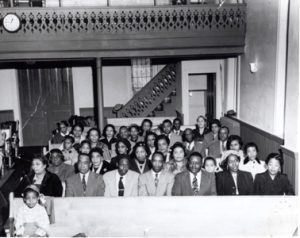
Jerusalem ME Church congregation, date unknown
Clinton AME Zion church, c. 1912 (Photo by Lewis Reed)
The Clinton A.M.E. Zion Church originally stood in downtown Rockville. The present building is post-modern in style, combining the simple forms and surfaces of modern architecture with references to architecture of past periods. At Clinton A.M.E. Zion, the steep roof and round window recall medieval Gothic and 19th-century Gothic Revival architecture, while the entrance porch, with its simple columns, suggests classical antiquity. The columns support a gable or pediment, which is playfully echoed by the gable shape rising from the flat roof behind the porch.
The First Montgomery Colored Baptist Church was founded around 1900. Its original building on Horner’s Lane was finished by 1902. Since 1910, it has been known as Mount Calvary Baptist Church. The original church was a one-room frame building. James Davis built the present building in the 1950’s and early 1960’s. He is said to have based the simple Gothic Revival design on a church in Bethesda. (Photo from Mount Calvary Baptist Church anniversary brochure)
Two gabled buildings run alongside each other, the north building housing the sanctuary. Both are constructed of buff-colored brick. A rose window adorns the peak of the sanctuary gable. A heavy molded brick surround frames the sharply pointed front door and is flanked by two simple doors. Buttresses divide the front wall into three bays and are also positioned along the sides. To the south, the building has a plain façade with a simple round window in the gable. The north side steps back, creating an interesting jagged outline with a sense of depth.
The Crusader Baptist Church was founded in 1985 by Reverend Rodney T. Davis. It is now housed in the old Lincoln High School building.
(Photo from Crusader Baptist Church social media)
Schools
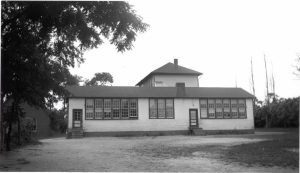
Public schooling was available for Black children in Maryland starting in 1872. However, students could attend county schools, such as Rockville Colored Elementary School on North Washington Street, only up to seventh grade. Then, if they could afford to do so, students went on to high school in the District of Columbia. They had to ride the trolley or live with relatives in Washington during the week. In 1927, the first high school for Black children was built with Rosenwald funds in Rockville (pictured at right, with the elementary school behind it).
Petition for an African American School in Rockville
Education has always been a pillar of Black communities, exemplified by those emancipated in Rockville after the Civil War. In February and March of 1867, twenty Rockville Black men pledged to support a school by taking responsibility for money “as may be necessary to pay the board and washing [laundry] of the teacher and to provide fuel and lights for the Schoolhouse.”
The men who signed the 1867 petition were a mixture of free men and former slaves who had gained freedom through a variety of methods. A few were born free, some manumitted, others purchased their freedom or joined the military. Most had been freed on November 1, 1864 by the state constitution; at least one was in the District of Columbia when an Act of Congress freed all enslaved persons living there. The signers ranged in age from 21 to 62 years of age. Most were illiterate; only five were able to sign their own names. Their occupations included laborers, farmhands, minister, pump maker, carpenters, shoemakers, whitewasher, and farmer. According to the Freedmen’s Bureau account of black property owners in Montgomery County in 1867, only five of the twenty owned land and personal property; six had only personal property, and nine had neither. As a sign of increasing prosperity, three more owned land by 1880.
The signers lived mainly in four areas: Martins Lane, Middle Lane/Washington Street, Great Falls Road, and Avery Road, or on the property of their employees. Most of these men lived out their lives in Rockville. The last one died in 1917. They were respected members of the community, leaders at the Jerusalem Methodist Episcopal (M.E.) Church and among the founders of Clinton African Methodist Episcopal (A.M.E.) Church.
The following petition signers were residents of Lincoln Park:
Solomon Williams circa 1812–? Solomon Williams’ origins are unknown. He was not listed among the slaves whose owners sought compensation after emancipation, but his wife Sidney, most of their children and some of their grandchildren were listed as property of May A. and Nannie Wootten. He was among the men who sought help from the Freedmen’s Bureau in recovering money collected for the school from John Mortimer Kilgour. In August 1868, he was also one of the trustees who purchased land from Mary Brashears for a school. Solomon Williams apparently had considerable influence. His sons, Richard and Hezekiah, and a son-in-law, Hillary Powell, added their names to the petition. Henry Dove and Tilghman Graham were extended family members.
Reuben Hill c. 1832–1915 At the time of emancipation, Reuben Hill was enslaved by Samuel Stonestreet, Clerk of the Circuit Court. He was the third signer, with his mark, of the petition for a school on February 14 . Reuben’s marriage to a free woman, Rachel, was not recognized until after emancipation. They had seven children. Reuben and Rachel legally married in 1871 and purchased acreage near Lincoln Avenue, east of Horners Lane. They were one of five Black families recorded as landowners by 1879 in the area that would become Lincoln Park. Their property grew in 1880 when former confederate soldier Simeon Berry purchased land on Lincoln Avenue. Two days later, he sold half the land to Reuben’s oldest son and willed the remaining land and dwelling (now 305 Lincoln Avenue) to Reuben himself. The Hill family was well known in Rockville and Reuben worked at a local hotel and officiated at weddings and funerals. His son Reuben married George Blair’s daughter. Hill descendants continue to live in Montgomery County. See a picture of the Hill house in the section below about Lincoln Park architecture.
Lincoln High School
One of the most important educational landmarks in Montgomery County is Lincoln High School, located on Stonestreet Avenue in Lincoln Park. After the Rosenwald building on Washington St. had become overcrowded, an abandoned building from Takoma Park was moved to the Lincoln Park site, covered with brick, given an Art Deco door surround, and opened as Lincoln High School in 1935. The first principal, Dr. Parlett Moore, headed a staff of five teachers who taught a general curriculum along with agricultural, vocational, and home economics courses. The school provided an opportunity for young people from all over the county to learn together.
In the late 1940’s, Lincoln High bought surplus quonset huts from the Navy. Over the years, they served as a gymnasium, an auditorium, and for other purposes. In 1950, Carver High School on Hungerford Drive replaced Lincoln, which then became the only junior high school in the county for Black students. Carver High School was closed in 1961 with the completion of the school integration plan, and repurposed as the administration building for the School Board. Lincoln High school is the oldest high school building dedicated to Black students still standing today.
Benevolent Societies
Nineteenth-century African-American communities started their own organizations to handle the expenses of illness and death and to care for widows and orphans. Lodges were usually associated with the church.
The Order of the Galilean Fishermen was a statewide organization founded in 1856. The local chapter, Eureka Tabernacle #29, was established in 1912. Members paid into the treasury and were given $4 weekly in the event of illness or injury and funeral expenses up to $100. The Galilean Fishermen established Fishermen’s Cemetery at the corner of Frederick Avenue and Horners Lane in 1917. It is now known as the Mt. Calvary Baptist Cemetery. Earlier there were several family burial plots, such as the Martin family’s on North Horner’s Lane, as well as a small community burial plot on Frederick Avenue. When a house was erected on the Frederick Avenue property in the 1960’s, the bodies were reinterred in Fishermen’s Cemetery.
The Oddfellows Lodge was also in the same area. Across the street stood the famous Mr. T. Johnson store and pool hall on North Washington Street. The Oddfellows organized a field day for school children, a major annual event.
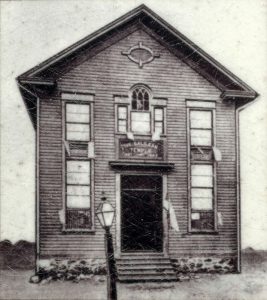
Galilean Temple
Businesses
Johnny’s Market has been a Lincoln Park fixture for decades. Johnny’s had a pool room and piano in the back and was a gathering place for teenagers. In earlier years, the market was known as the Claggett and Waters Market, for its then proprietors, Robert and Marilyn (Shelton) Claggett and Harry and Annie (Shelton) Waters. At one time, there had been four separate small markets in different sections of Lincoln Park.
At 311 Lincoln Avenue is the Harris House / Hicks Barber Shop. The original 1940 house is a tiny building, originally one room. For more than forty years, until it closed in 1985, this was the barbershop for Lincoln Park.
(Photo featured in the Montgomery Journal)
The section of the current Rockville Town Center which faces North Washington Street was owned by black families such as the Duffins, the Reddicks, and the Johnsons. There were five or six houses and the Rockville Colored Elementary School. The original Zion A.M.E. church was nearby. Lincoln Park residents shopped at the A&P, the Sanitary grocery store that later became the Safeway, Mr. Day’s meat market, and the Piggly Wiggly.
Fire Department
By the turn of the twentieth century, Rockville’s fire safety was in the hands of black uniformed volunteers supervised by George Meads, an African-American delivery man and deputy sheriff. Meads refused payment for his services as a fireman.
Henry Shelton, Sr., of Lincoln Park, (pictured c. 1910, in his fireman’s uniform, with his wife and son) was a captain in this first, loosely organized fire department.
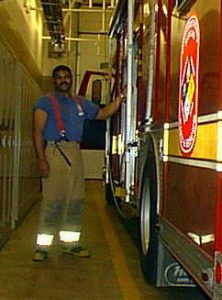
After a fire nearly consumed the downtown business district, the Rockville Volunteer Fire Department was formed in 1921. Continuing a family tradition, Shelton’s great-grandson, Timothy Bell, joined the department in 1985. The photo below was taken when he served with Montgomery County’s Hazardous Materials unit.
Recreation
In the summer, Lincoln Park residents swam at Sparrow’s Beach near Annapolis. Most also attended camp meetings at Emory Grove. Camp meetings ran for four consecutive Sundays. Famous preachers spoke in the morning, followed in the afternoon by picnics, bake sales, and baseball games. The Black community held its own horse show in both Norbeck and Sandy Spring. In Rockville, there were the Memorial Day parade and homecoming picnics.
The Howard Theater in Washington was one of a circuit of East Coast theaters for African-American entertainers. Others stops on the circuit were the Regal in Baltimore and the Apollo in New York City’s Harlem. Percie Brown recalled many trips to the Howard, where she and her friends heard such performers as Cab Calloway, Ella Fitzgerald, and Pearl Bailey.
The Red Barn on Frederick Avenue, built in 1930, contained a movie house. It was converted into apartments in 1951. Now a single family home, built in 1990 and 1991, occupies the lot.
A dance hall, located on Frederick Avenue where the Rocklin apartments stand, provided facilities for dance classes. Mrs. Fraley, a teacher at Dunbar High School in Washington, taught classes several times a year.
The Lincoln Park Community Center now stands on land once owned by the Johnson family and provides classes and recreation.
Clarence ‘Pint’ Isreal, 1918-1987. Inscription reads ‘Yours sincerely in sport’. (photo courtesy of Robert Isreal and Peerless Rockville)
Baseball
Clarence Charles “Pint” Isreal was Rockville’s very own baseball star and Negro World Series champion. Born in Marietta, Georgia, on February 15, 1918, Clarence Isreal grew up in Lincoln Park. After graduating from Lincoln High School in 1935, “Pint” played locally and in 1938 he signed with the Washington Royals, a semi-pro barnstorming team. In 1939, he played a higher level of semi-pro ball with the Washington Royal Giants, a team that played at Griffith Stadium in DC.
In 1940, Isreal joined the Newark Eagles team of the Negro National League. At second and third base, he was a hustler, a good fielder with good speed. From 1943 to 1945, he served in the military, starring on various baseball teams. In 1946, Isreal resumed his career with the Eagles. That season the team won the Negro National League Pennant. In the World Series against the Kansas City Monarchs, “Pint” started at third base in three games. An injury prevented his further participation. In the pivotal Game Six, he drew a walk and moved around the bases to score the Eagles’ first run. The Eagles won the game to extend the series, and went on to win the championship in the deciding Game Seven.
Isreal signed with the Homestead Grays in 1947, where Hall of Famer Bucky Leonard was among his teammates. “Pint” had been loaned to the Grays for two exhibition games in 1949, when additional Hall of Famers Josh Gibson and Cool Papa Bell were also with the team. The following year, having retired from baseball, Isreal took a job as a technician at the National Institutes of Health, where he worked until 1973. But “Pint” continued to play ball, manage teams, and umpire games. In the late forties, he and his brothers Elbert and Dewey played locally on a team called the Legionnaires. Elbert Isreal went on to play infield for the Philadelphia Stars of the Negro American League in 1950.
In his community, “Pint” Isreal was known as a humanitarian and active church member. He served the youth of Lincoln Park as co-founder of the Black Angels Boys Club.
Clarence Isreal died on April 12, 1987. In Lincoln Park, he is well remembered and has been memorialized by the City of Rockville, which named a park with a ball field in his honor. In 2022, Bethesda Big Train Baseball established an annual Clarence “Pint” Isreal Juneteenth Classic game.
Below left: Rockville’s Black baseball team, c. 1900 (Lincoln Park’s Louis Hicks is fourth from left in the back row)
Below right: the Newark Eagles