
The Immigrant Experience Collection
 This collection represents a collaborative project created by Montgomery College’s Anthropology Department and Montgomery History. Dr. Maria Sprehn, along with several of her student assistants, conducted these interviews with first- and second-generation immigrants and their families over the course of many years (2018-2023). Montgomery History’s archivist Sarah Hedlund has organized their stories into a dynamic online exhibit called “The Immigrant Experience in Montgomery County.”
While the exhibit displays each person’s story through a visual overview and features clips from their interviews, this collection contains the full interviews with transcription, all images, and any other materials donated by the interview subjects, who are valued members of Montgomery County’s immigrant population.
Explore the collection below, organized by interview subject.
Felicien Bidzimou (Republic of Congo)
Felicien Bidzimou is from Pointe-Noir in Congo-Brazzaville, officially known as the Republic of Congo, where he taught history in a public high school. After two civil wars occurred in Brazzaville, free speech became very limited, and as a teacher he was even more in danger of being targeted by those in power for promoting unpopular opinions. Because of this situation, he took an opportunity to leave his country in 2004. He lived first near Atlanta, Georgia, then spent six months working in Alaska, finally settling in the Washington, D.C. area where he used the money he had saved to bring his wife and children to the U.S.
He moved his family to Montgomery County in 2008 to attend Montgomery College, then applied for graduate school at Howard University in 2013, where his existing master’s degree in history (earned in Congo) allowed him to begin a doctoral program. He received his Ph.D. in sociology from Howard in 2020.
Juana Gonzalez (El Salvador)
Juana Gonzalez left Cacaopera, El Salvador, for the United States in 1978 because job opportunities in her home country were few and far between. While her childhood dream was to become a businesswoman, her motivation for leaving El Salvador was to provide a better education and future opportunities for her children. She worked as a housekeeper in Maryland for a diplomatic family and for a time was separated from her children, Pablo, Sara, and Ana, who had remained in El Salvador. They were able to join her a few years later. Juana was able eventually opened her own Mexican and Salvadoran restaurant and food truck business in Derwood. Not only did she reach her goal to become a businesswoman, but she also supported and guided her children in reaching their educational goals. All of her children went on to professional careers.
Will Jawando (Nigeria)
Will Jawando’s father, Olayinka Jawando, escaped the violence of the Nigerian-Biafran War when he won a scholarship to study at Fort Hays State University in Hays, Kansas. There he met Will’s mother Kathleen Gross, who had been born and raised in Kansas and the two married in 1975, despite objections from her family.They soon moved to Long Branch, an already-diverse and affordable community within Silver Spring, in Montgomery County, Maryland. Their son, William Opeyemi Taofik Alabi Jawando, was born in 1983. His parents divorced when he was young, and Will was finallyu able to reconnect with his Nigerian roots later in life. When Will was elected for the first time to the Montgomery County Council, he wore to the inauguration a traditional Nigerian agbada, the formal dress of the Yoruba, to simultaneously honor the memory of his father and his Nigerian heritage.
Olena Korytnyk (Ukraine)
Olena’s father, economist Hryhorij Kozak, had already been imprisoned for speaking out against the Russian eradication of Ukranian culture when she and her sister were born in the midst of World War II. She spent her childhood in various displaced persons camps throughout Europe before her family landed refugee status in Australia. There she met her future husband and together they traveled to the United States in 1957 where he did cancer research for the next 30 years. Olena’s children settled in the Washington, D.C. area and she moved here to be near them following the completion of her own education and career. Spanning a dozen locations and nearly 100 years, Olena’s remarkable story is separated into two themes: flight from war and conflict and migration for love.
The Nadkarni Family (India)
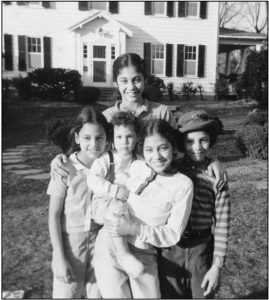
Moreshwar V. Nadkarni, born in Thana, India, left for the U.S. in 1946 after receiving a scholarship to study pharmacology at the University of Iowa. He completed his master’s and doctorate degrees but also met Goldie Hema Pechenuk, a first-generation Russian from an orthodox Jewish family. Abandoning the arranged marriage planned for his back in India Moreshwar married Goldie and the couple spent close to 50 years together in Montgomery County, starting a large extended family that later included five children and eleven grandchildren. The notable careers of their children underscore the high expectations and steadfast values of the Nadkarnis as parents, pioneers who looked beyond society’s racial categories and embraced multicultural appreciation.
Anita Terauds (Latvia)
After eleven years spent in displaced persons camps following the invasion of Latvia by the Soviet Union in 1940, Anita and her family finally arrived in Washington, D.C. to start a new life. Eventually Anita married John Terauds and moved to Montgomery County where their family grew with three daughters and six grandchildren. She also became the Secretary General of the American Latvian Association, headquartered in Rockville, a position she used to strengthen the American Latvian community, their identity, culture, and language. In 2006, the President of Latvia awarded her the Cross of Recognition